Need Help? Contact us ...






BLOG 3 The Vocabulary of Modern Slavery
The Vocabulary of Modern Slavery: Decoding the Language That Keeps People Trapped
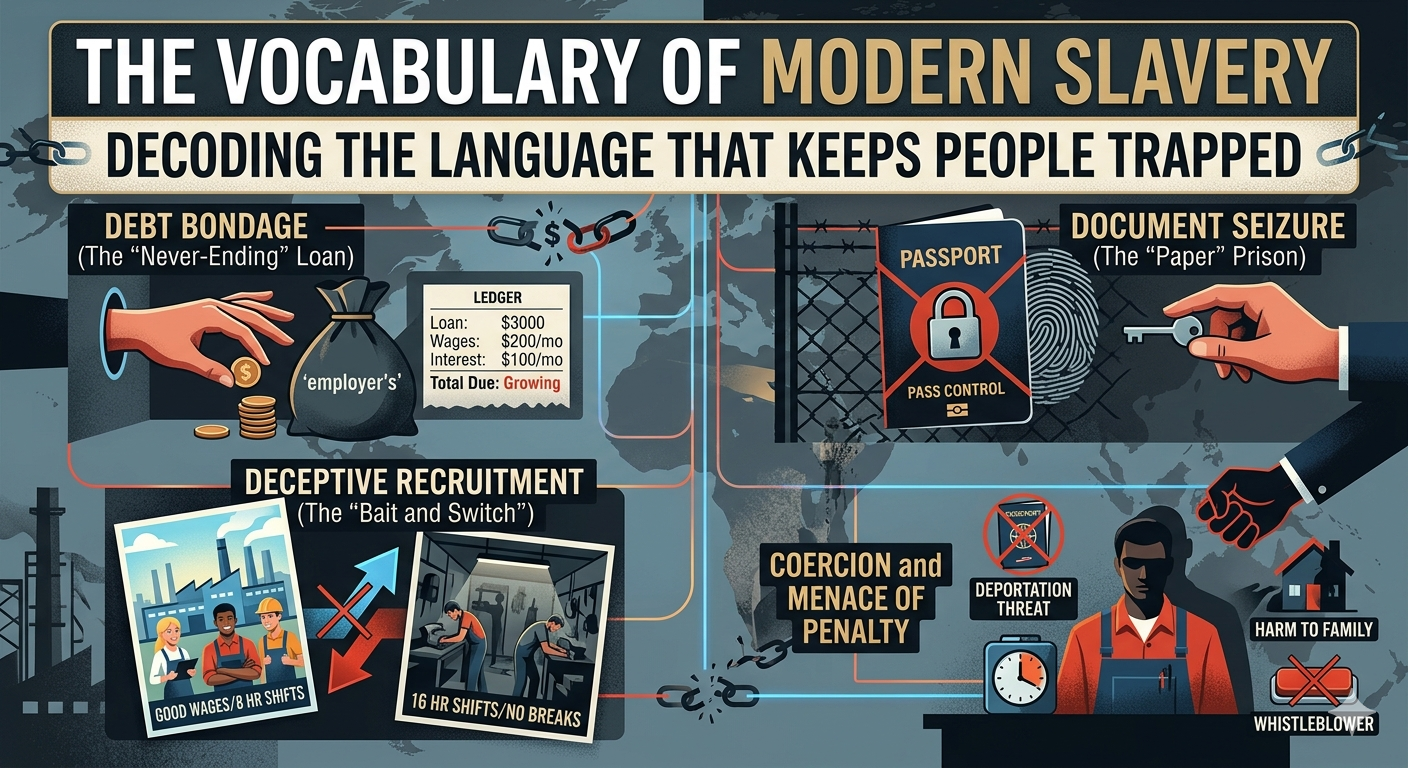
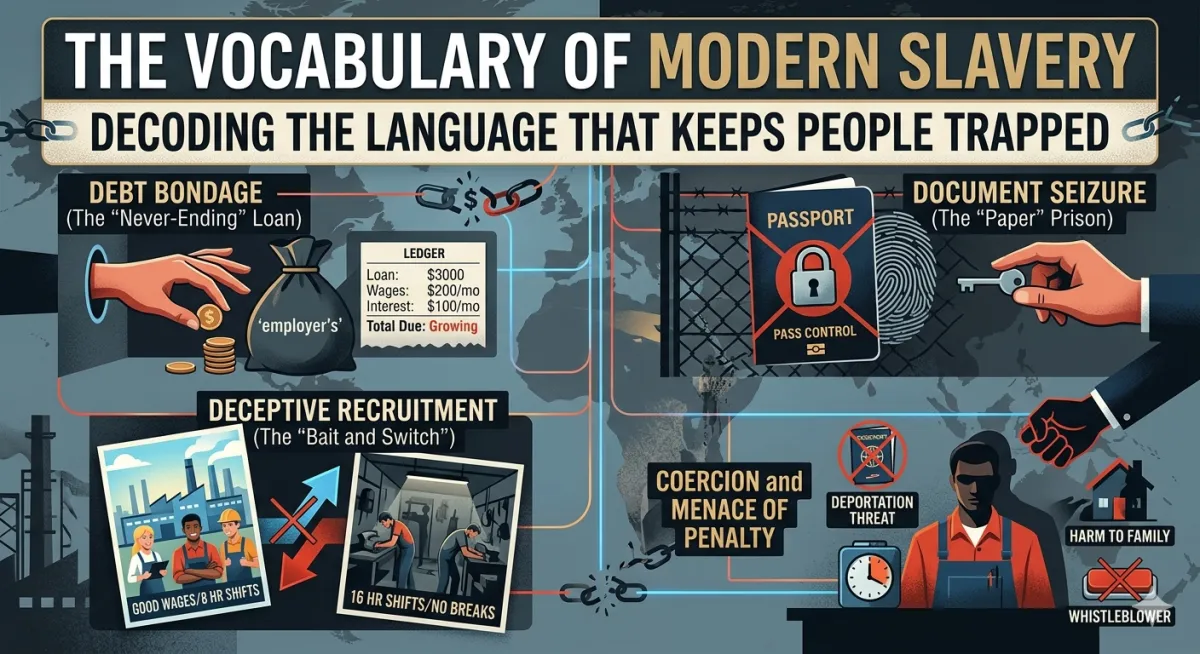
If you were to walk into a corporate boardroom or a government briefing, you’d hear a lot of "sanitized" language. You’d hear terms like recruitment irregularities, labor non-compliance, or unauthorized subcontracting.
But on the ground—in the mines, the factories, and the farms—those words translate into lived nightmares. If we want to dismantle these systems, we have to understand the vocabulary traffickers use to hide their crimes.
Let’s look at these terms through the story of Sofia, a woman who left her home in the Philippines for what she thought was a legitimate job in a garment factory.
1. Debt Bondage (The "Never-Ending" Loan)
Before Sofia even stepped foot in the factory, she was already a victim. A recruiter told her the plane ticket and visa would cost $3,000—money she didn't have. He offered her a "loan" to cover it.
•The Reality:This is Debt Bondage. Sofia’s entire paycheck was taken every month to "pay down" the loan. But with 20% interest and charges for her "bed" in a cramped dormitory, the debt never went down. She was effectively working for free.
•The Scale:Debt bondage is the most common method used to enslave people in global supply chains today.
2. Document Seizure (The "Paper" Prison)
On her first day, the factory manager asked for Sofia’s passport to "process her work permit." She never saw it again.
•The Reality:This is Document Seizure. Without her passport, Sofia couldn't leave the country, rent an apartment, or even walk past a police checkpoint without fear of arrest. Her identity became a tool of control.
•Why it works:It turns a foreign country into a prison without walls.
3. Deceptive Recruitment (The "Bait and Switch")
The brochure Sofia was shown in the Philippines featured a clean, modern facility with 8-hour shifts and weekends off. When she arrived, she found herself in a windowless room, working 16-hour days, seven days a week.
•The Reality:This is Deceptive Recruitment. When the reality of the work is different from the promise made, it is a hallmark of trafficking. If she had known the truth, she never would have signed the contract.
4. Coercion and Menace of Penalty
Sofia wanted to complain to the local authorities, but the manager told her that if she spoke to anyone, he would call immigration and have her deported immediately. He also hinted that he knew where her family lived back home.
•The Reality:This is Coercion. It isn't always physical violence. It is the psychological threat of a "penalty"—deportation, loss of wages, or harm to loved ones—that forces a person to keep working against their will.
Why These Words Matter
When a brand says they have "found issues with recruitment fees" in their supply chain, what they are actually saying is that people like Sofia are in debt bondage. By learning this vocabulary, we stop seeing "compliance issues" and start seeing human rights violations. We can’t fix what we can’t name.
👉Download our guide — because behind every “compliance issue” is a human story you can’t afford to ignore.


FOLLOW US


COMPANY
LEGAL
Copyright 2026. Rahab's Daughters. All Rights Reserved.