





New Blog Post
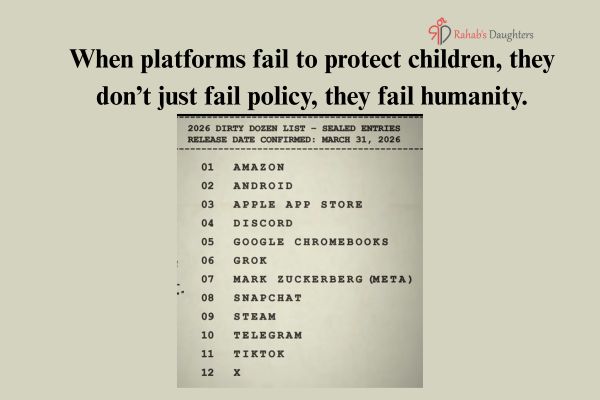
When platforms fail to protect children, they don’t just fail policy, they fail humanity.
The Data We Cannot Ignore
The conversation around technology and child safety is often framed in abstract terms risk, harm, exposure. But the reality is far more concrete, and far more urgent.
An estimated 100,000 children are exploited globally every day
According to global reports, 1 in 5 children online are approached by a predator each year
The National Center for Missing & Exploited Children (NCMEC) received over 36 million reports of suspected child sexual exploitation in 2023 alone
Europol has warned that online platforms are now central to the recruitment, grooming, and control mechanisms used in trafficking networks
This is not a marginal issue. It is a systemic, data-backed global crisis and technology sits at its core.
WHEN AI NORMALISES ABUSE, IT IS NO LONGER INNOVATION.
The dirty dozen 2026: Platforms Under Scrutiny
The 2026 Dirty Dozen List released by the National Center on Sexual Exploitation identifies twelve entities whose platforms, policies, or systems have raised serious concerns regarding sexual exploitation:
Amazon
Android
Apple App Store
Chromebook
Discord
Grok
Snapchat
Steam
Telegram
TikTok
X
Mark Zuckerberg
These platforms collectively serve billions of users, including a significant proportion of minors. Their scale is precisely what makes any safety gap exponentially dangerous.
AI and Algorithms: Accelerating the Risk
Artificial intelligence and algorithm-driven systems are fundamentally reshaping how exploitation occurs.
AI-generated content has made it possible to create synthetic sexual material, including deepfake abuse imagery, at scale
Recommendation algorithms on platforms like TikTok and X can rapidly expose users to harmful content based on engagement patterns
Chatbot systems, including tools like Grok, introduce risks of simulated grooming interactions and boundary erosion, particularly for minors
According to Europol, AI is expected to significantly increase both the volume and accessibility of child sexual abuse material (CSAM) in the coming years.
This is not theoretical, it is already beginning.
Platform-Specific Risk Environments
Different types of platforms enable different stages of exploitation:
1. Messaging & Social Platforms
Apps like Snapchat and Telegram are frequently cited in law enforcement cases due to:
Disappearing messages
End-to-end encryption
Limited traceability
These features, while privacy-enhancing, are also exploited for grooming and sextortion.
2. Community & Gaming Platforms
On Discord and Steam:
Predators integrate into youth communities
Grooming often begins through shared interests
Communication can shift from public to private channels quickly
Gaming-related platforms have been repeatedly flagged in investigations involving minors.
3. App Ecosystems & Devices
Systems like Android and the Apple App Store control access to millions of apps. Weak vetting or enforcement can allow:
Unsafe apps to reach minors
Inadequate parental control mechanisms
Exposure through devices like Chromebook widely used in schools
4. Leadership & Platform Governance
Figures like Mark Zuckerberg represent decision-making at scale—where policies on moderation, encryption, and safety features directly influence global child safety outcomes.
Beyond the Twelve: Expanding Risk Across the Ecosystem
The broader digital environment reinforces the same concerns:
AI chatbot platforms like Character.AI are facing lawsuits alleging exposure of minors to sexualised conversations and psychological harm
Reddit continues to host communities linked to image-based sexual abuse, including non-consensual content
Roblox has been repeatedly cited in cases involving grooming and exploitation; recent safety updates are still under scrutiny
Spotify has introduced direct messaging and hosts explicit content disguised as podcasts, increasing risk exposure for minors
These are not isolated failures; they reflect systemic gaps across multiple platform types.
The Economics of Inaction
The global human trafficking industry is estimated to generate over $150 billion annually, with a significant portion linked to sexual exploitation.
Technology has:
Reduced operational costs for traffickers
Expanded reach across borders
Increased anonymity and reduced risk of detection
At the same time, platform safety investments often lag behind growth and monetisation strategies.
This imbalance is measurable and consequential.
What the Data Demands
The numbers point to one conclusion:
Current safeguards are not keeping pace with technological advancement.
To address this, experts and advocacy bodies call for:
Mandatory age verification systems beyond self-reporting
AI-driven detection tools for grooming and CSAM
Transparent reporting metrics from platforms
Stronger regulatory enforcement and financial penalties
Cross-border cooperation, recognising the global nature of digital trafficking
From Awareness to Action
The 2026 Dirty Dozen List is not just a collection of names it is a reflection of where systems are failing at scale.
The data is clear.
The risks are measurable.
The patterns are repeated.
What remains uncertain is not the problem but the response.
Because at this point, inaction is not a lack of awareness.
It is a lack of prioritisation.
Children are not collateral damage of the digital age.
They are its most vulnerable users and the data makes one thing undeniable:
Without urgent, enforceable accountability, technology will continue to scale harm faster than we can contain it.
Try this
When Platforms Fail Children, They Fail Humanity
There are moments where data stops being abstract and starts becoming deeply personal.
This is one of them.
Because when we talk about child safety online, we’re not talking about “risk” or “exposure” in some distant, theoretical way. We’re talking about real children. Real lives. Real trauma.
And right now, the data is telling us something we cannot afford to ignore.
The Data We Cannot Look Away From
Let me be clear—this is not a fringe issue.
This is a global crisis, happening at scale:
An estimated 100,000 children are exploited globally every single day
1 in 5 children online are approached by a predator each year
The National Center for Missing & Exploited Children received over 36 million reports of suspected child sexual exploitation in 2023 alone
Europol has explicitly warned that online platforms are now central to recruitment, grooming, and control in trafficking networks
Pause on that for a moment.
This isn’t happening on the edges of the internet.
This is happening at the core of it.
When AI Starts to Normalise Abuse
We are living in a moment where technology is evolving faster than our ability to protect the most vulnerable.
And I need to say this plainly:
When AI normalises abuse, it is no longer innovation.
We’re now seeing:
AI-generated sexual content—including deepfake abuse imagery—being created at scale
Algorithms pushing harmful content faster than safeguards can catch it
Chatbots blurring the line between interaction and manipulation, especially for young users
This isn’t hypothetical. It’s already happening.
And according to Europol, it’s only going to accelerate.
The “Dirty Dozen” A Wake-Up Call
In 2026, the National Center on Sexual Exploitation released its “Dirty Dozen” list highlighting platforms where safety concerns are significant.
These platforms serve billions.
Which means when something breaks it doesn’t break quietly.
It breaks at scale.
How Exploitation Actually Happens Online
Different platforms enable different parts of the same pipeline.
Messaging & Social Platforms
Apps like Snapchat and Telegram enable:
Disappearing messages
Encryption
Limited traceability
These are powerful tools for privacy but also for grooming and sextortion.
Gaming & Community Platforms
On Discord and Steam:
Predators embed themselves in communities
Grooming starts through shared interests
Conversations move from public to private quickly
App Ecosystems & Devices
Platforms like Android and the Apple App Store control access to millions of apps. Weak safeguards mean:
Unsafe apps reach children
Parental controls fall short
Devices used in schools become access points
Leadership Decisions
At the top, decisions about moderation, encryption, and safety features shape outcomes globally.
This is not just a tech problem.
It is a governance problem.
This Is Bigger Than Twelve Companies
Let’s not pretend this begins and ends with a list.
Across the ecosystem, we’re seeing the same patterns:
AI chatbot platforms exposing minors to harmful interactions
Online communities hosting non-consensual content
Gaming environments repeatedly linked to grooming cases
Streaming platforms blurring lines between content and communication
This is systemic.
And systems don’t change without pressure.
The Economics Driving This Crisis
Here’s the uncomfortable truth:
Human trafficking generates over $150 billion annually.
Technology has:
Reduced costs for traffickers
Expanded reach globally
Increased anonymity
Meanwhile, safety investments often lag behind growth.
So we have a system where harm scales faster than protection.
That’s not accidental.
That’s a prioritisation problem.
What Needs to Change
The data is clear. The solutions are not mysterious.
We need:
Real age verification systems
AI used for detection—not just engagement
Transparent reporting from platforms
Regulatory enforcement with real consequences
Global cooperation to match a global crime
But here’s the part people don’t say enough:
Policy alone will not save these children.
Because while systems catch up…
Children are still being targeted today.
From Awareness to Action
This is where I stop speaking as a strategist
…and speak as a survivor.
Because I know what it means to fall through the cracks of systems that should have protected you.
And I know what it takes to rebuild a life after exploitation.
At Rahab’s Daughters, we don’t just talk about the problem.
We:
Identify trafficking patterns using data and OSINT
Intervene through outreach and partnerships
Support survivors with housing, care, and long-term recovery
Equip communities to recognise and prevent exploitation
We are in this fight every single day.
But we cannot do it alone.
A Direct Ask
If this moved you even a little don’t scroll past it.
Because awareness without action doesn’t change outcomes.
We need people who are willing to stand in the gap.
👉 Become a monthly partner
👉 Give what you can $20, $50, $100
👉 Help us stay in this fight
Because every donation:
Funds real interventions
Supports real survivors
Helps us push back against a system that is currently failing children
And right now, staying in this fight matters more than ever.
Children are not collateral damage of the digital age.
They are its most vulnerable users.
And if technology continues to scale harm faster than we scale protection…
Then the question is no longer what’s happening.
It’s what we chose to do about it!


FOLLOW US


COMPANY
LEGAL
Copyright 2026. Rahab's Daughters. All Rights Reserved.